



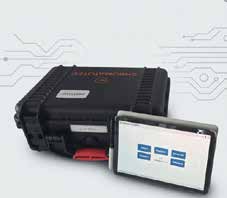
CHROMATOTEC® presents the μ-airTOXIC, a portable TD-GC-PID analyzer designed for the separation, identification and quantification of tracelevel volatile organic compounds (VOCs). Compact, lightweight and made in France, the μ-airTOXIC is designed for fast and easy deployment directly in the field. Weighing less than 6 kg, it combines high analytical performance with the mobility required for on-site measurements. Its integrated analytical preconcentration trap system provides exceptional sensitivity, with detection limits down to 10 ppt for benzene.
The temperature-programmed chromatographic oven significantly improves selectivity, enabling accurate separation of individual VOCs, even in complex matrices. A PID heated up to 200°C ensures excellent signal stability and allows the analysis of heavier compounds such as naphtalene.
Developed over three years of R&D, the μ-airTOXIC incorporates proven components and analytical methods from the airTOXIC compliant with EN-14662-3 standard. It combines sensitivity, selectivity and portability in a single instrument designed specifically for field applications.
Depending on the selected analytical method, the μ-airTOXIC can be used to monitor BTEX, VOCs, hydrocarbons, naphtalene and biogenic VOCs, with more than 60 compounds available across different applications. Its integrated autonomy and portable design make it suitable for measurement campaigns in industral environments, ambient air monitoring and emission source characterization. The instrument can be operated via Wi-Fi from a tablet or smartphone, allowing users to select analytical methods, visualize chromatograms, and easily save or export results.
Two main configurations are available:
- μ-airTOXIC BTEX – optimized for ultra-trace BTEX monitoring;
- μ-airTOXIC C6C12 – designed for the characterization of more complex VOC.
With μ-airTOXIC, CHROMATOTEC® introduces a new generation of portable GC-PID analyzers, combining chromatographic performance, ease of use and mobility to meet the growing need for reliable VOC monitoring directly in the field.